Black Flags and Windmills by Scott Crow
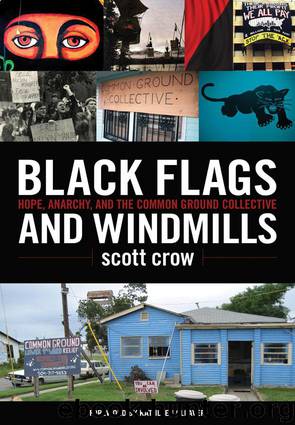
Author:Scott Crow
Language: eng
Format: mobi, epub
Publisher: PM Press
Published: 2011-04-22T20:00:00+00:00
With Thunder in Our Hearts
In this world, there is a kind of painful progress. Longing for what we’ve left behind, and dreaming ahead.
—Tony Kushner, Angels in America, Part Two: Perestroika
Gulf Tides and First Nations
Rita didn’t strike New Orleans directly. It hit the coast at the Texas-Louisiana border, bringing a storm surge that breached the levees of the lower wards again, flooding them. Once more, the broader Gulf Coast area from Texas to Mississippi was under water.
Earlier, just after Katrina, we had learned by word of mouth of severe flooding in remote places along the coastal areas. Someone who had just returned from there described deep waters covering scattered trailer homes in out of the way towns and dead bodies abandoned on lonely roads. People had scrambled to the few dry places they could: rooftops, patches of dry land, various overcrowded churches, and a small recreation center. Longstanding environmental degradation of the Coastal wetlands in the name of commerce and progress had reduced the natural barrier protections from the tides to nothing.
People needed food and medical attention immediately. We had made initial scouting missions during mid to late September as far as we could reach into some outlying areas along the coast a week before Rita hit. With our limited capacity, we hadn’t been able to get far into the heavily flooded areas of the small bayou communities so our focus had remained mostly within New Orleans. Tucked away in those bayous and coastal lowlands, there were many unseen yet vibrant communities, made up of small towns, villages, and sometimes just isolated houses. They were home to numerous small tribes of First Nation peoples, including the Biloxi Chitimacha, Houma, and Pointe-au-Chien, as well as Vietnamese fishing villages and small French Cajun and black communities. Thousands of people in these communities had lost their homes from Katrina. The succeeding hurricane water almost finished them off.
It was another hidden disaster, among many that the media ignored that fall. As in so many areas, the Red Cross, FEMA, and any number of agencies that should have been there to help, were absent. As with so many other historically forgotten rural and urban communities, those who assume power didn’t prioritize them.
While the worst of Rita’s impact had lessened, the storm’s rains were still beating down when we sent our van into flooded Lake Charles, west of New Orleans, to drop off supplies. The next day I returned to the region, still weak. but standing. We rented a truck and headed to Houma and Pointe-au-Chien to transport aid and medics near where people were gathered. We also sent a crew with our little boat to reach people stranded on the rooftops of their homes. It was beyond our scope, but we had to do something. The first scouting missions felt like my arrival to New Orleans after Katrina: destruction and sadness everywhere. The sixteen-foot box truck and the medical van set up in different communities daily, doing mobile distribution until the supplies were gone or no one else needed medical help.
Download
This site does not store any files on its server. We only index and link to content provided by other sites. Please contact the content providers to delete copyright contents if any and email us, we'll remove relevant links or contents immediately.
| Africa | Americas |
| Arctic & Antarctica | Asia |
| Australia & Oceania | Europe |
| Middle East | Russia |
| United States | World |
| Ancient Civilizations | Military |
| Historical Study & Educational Resources |
Cat's cradle by Kurt Vonnegut(15441)
Pimp by Iceberg Slim(14665)
4 3 2 1: A Novel by Paul Auster(12511)
Underground: A Human History of the Worlds Beneath Our Feet by Will Hunt(12145)
The Radium Girls by Kate Moore(12093)
Wiseguy by Nicholas Pileggi(5841)
The Fire Next Time by James Baldwin(5503)
Perfect Rhythm by Jae(5460)
American History Stories, Volume III (Yesterday's Classics) by Pratt Mara L(5337)
Paper Towns by Green John(5247)
Pale Blue Dot by Carl Sagan(5080)
A Higher Loyalty: Truth, Lies, and Leadership by James Comey(5017)
The Doomsday Machine by Daniel Ellsberg(4545)
The Mayflower and the Pilgrims' New World by Nathaniel Philbrick(4540)
Killers of the Flower Moon: The Osage Murders and the Birth of the FBI by David Grann(4488)
The Sympathizer by Viet Thanh Nguyen(4444)
Too Much and Not the Mood by Durga Chew-Bose(4386)
The Borden Murders by Sarah Miller(4380)
Sticky Fingers by Joe Hagan(4253)
